
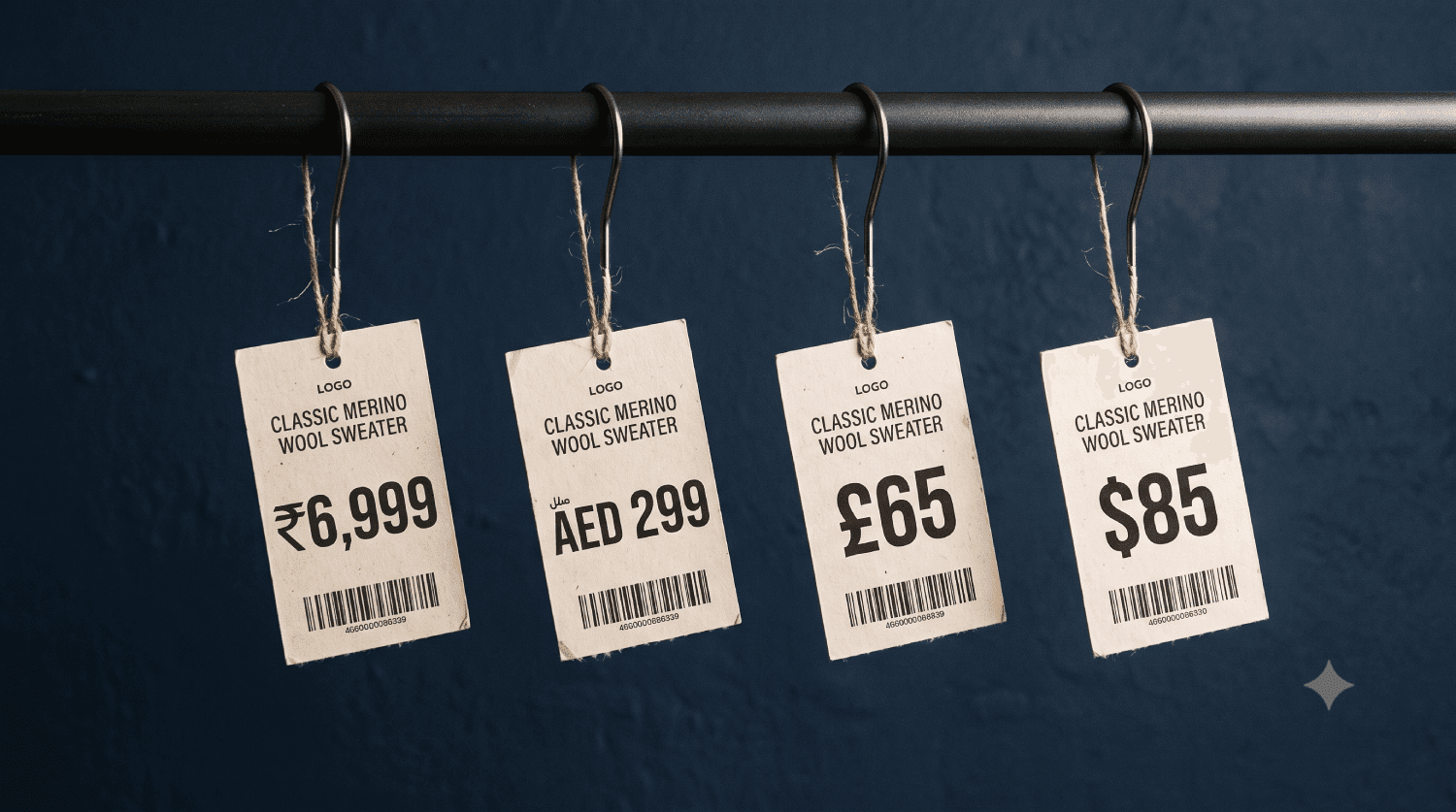
How Much Does a Shopify Store Cost in 2026? India vs UAE vs UK vs US Agency Pricing
Last month a founder sent us a brief for a supplements store. Twelve SKUs, subscriptions, COD, a bundle builder. Nothing exotic.
She had four quotes in hand. The lowest was ₹28,000. The highest was ₹11,40,000. Same brief, same twelve SKUs, same deadline.
That spread is the real question hiding inside "how much does a Shopify store cost". The number itself is almost meaningless until you know what sits underneath it — and most pricing articles won't tell you, because the honest answer is uncomfortable for whoever is writing it.
So here is ours, itemised, with the parts that usually get left out of the quote.
The short answer
| Tier | India | UAE / Saudi | UK | US |
|---|---|---|---|---|
| Template setup | ₹25,000 – ₹80,000 | AED 2,000 – 6,000 | £800 – £2,500 | $900 – $3,000 |
| Solo freelancer | ₹80,000 – ₹2,50,000 | AED 6,000 – 18,000 | £2,500 – £7,000 | $3,000 – $9,000 |
| Boutique studio | ₹2,50,000 – ₹8,00,000 | AED 18,000 – 55,000 | £7,000 – £22,000 | $9,000 – $28,000 |
| Enterprise agency | ₹15,00,000+ | AED 90,000+ | £35,000+ | $45,000+ |
Those are build costs for a custom storefront — design and development, before you've spent a rupee on Shopify's subscription, apps, photography or ads.
Most D2C brands doing between ₹50 lakh and ₹15 crore a year land in the boutique studio row. Below it you are usually buying a theme with your logo dropped in. Above it you are usually paying for account managers, not better code.
Why the same brief gets quotes twenty times apart
You are not buying a website. You are buying hours.
This is the part that takes founders a while to accept. A Shopify store is not a product with a price tag — it is a block of someone's working time, and the price is their hourly rate multiplied by how carefully they intend to work.
A ₹28,000 quote is not a cheaper version of the ₹4,00,000 quote. It is roughly 25 hours against roughly 350 hours. The first one installs Dawn, uploads products, and ships. The second one maps your catalogue, designs your product page around how your customers actually decide, builds a cart drawer that doesn't fight the thumb, wires COD verification so you stop paying courier charges on fake orders, and tests all of it on a three-year-old Android on a 4G connection in a lift.
Both are "a Shopify store". Only one of them was built with your margin in mind.
Where the hours actually go
Here's the breakdown from a real mid-sized build — a wellness brand, 20 SKUs, India plus GCC shipping. Hours are rounded.
| Phase | Hours | What happens |
|---|---|---|
| Discovery and architecture | 20 | Catalogue structure, customer journeys, tech decisions, scope lock |
| UX wireframes | 35 | Home, collection, product, cart, checkout, account, content pages |
| UI design | 70 | Full visual design, mobile and desktop, component library, states |
| Theme development | 120 | Custom sections, blocks, metafields, the editor your team will actually use |
| Integrations | 45 | Payments, COD verification, shipping, WhatsApp, reviews, analytics |
| Content migration | 25 | Products, variants, images, SEO fields, redirects from the old store |
| QA and device testing | 30 | Real devices, real networks, real card and COD transactions |
| Launch and handover | 20 | DNS, redirects, tracking verification, training, documentation |
| Total | 365 |
At ₹1,100 an hour — a fair India studio rate in 2026 — that's about ₹4,00,000. At a London studio's £95 an hour, the same 365 hours is roughly £34,000.
Same work. The difference is where the chair is.
What a build costs by region in 2026
India
A competent Indian studio charges between ₹900 and ₹1,800 an hour. A senior Shopify specialist in Bangalore or Mumbai will quote at the top of that. Smaller cities — Nagpur, Indore, Coimbatore — run lower without the work being worse, because rent and salaries are lower.
Typical full custom build: ₹2,50,000 to ₹8,00,000.
What makes India genuinely different is domain knowledge that Western agencies simply don't have. COD is not a feature here, it's the default. If your developer hasn't dealt with RTO, fake-order filtering, pin-code serviceability, Shiprocket or Delhivery webhooks, and UPI intent flows on mobile, they will build you a store that works beautifully and bleeds money quietly.
UAE and Saudi Arabia
Agencies in Dubai, Abu Dhabi and Riyadh quote AED 18,000 to AED 55,000 for a comparable custom build, with Plus-level work going well past AED 90,000.
GCC builds carry costs that India and the West don't:
- Arabic and RTL. Proper right-to-left is not a translation plugin. Layout mirrors, icons flip, numerals and dates change, and your typography needs a second font stack that actually has the weights you designed with. Budget 25–40% on top of a single-language build, not 5%.
- Local payments. Mada in Saudi, Tabby and Tamara for buy-now-pay-later, Apple Pay dominance, and still a meaningful share of cash on delivery in both markets.
- Compliance. VAT at 5% in the UAE and 15% in Saudi, invoicing requirements, and in Saudi the e-invoicing rules that your accounting integration has to satisfy.
- Peaks that aren't Diwali. Ramadan, Eid and White Friday drive the calendar. A store that launches in week one of Ramadan without load testing is a bad week waiting to happen.
Plenty of GCC brands now hire Indian studios directly for the build and keep a local partner for marketing. The timezone gap is ninety minutes. That arrangement works well, and it's a large part of why our enquiries from Dubai have grown faster than any other market.
United Kingdom
£7,000 to £22,000 for a custom build at a decent independent studio. London rates run 30–40% above Manchester or Bristol for work of the same standard.
UK briefs tend to be heavier on accessibility and data protection than Indian ones — WCAG expectations are real, cookie consent has to be genuine, and GDPR shapes how you handle email capture. That's a few extra days, not a different project, but it belongs in the quote.
United States
$9,000 to $28,000 at a boutique studio; $45,000 and up at an agency with a sales team.
American quotes often include strategy work — positioning, messaging, conversion research — that Indian quotes treat as the client's job. If you're comparing a US quote to an Indian one line by line, check whether you're comparing the same scope. Frequently you aren't.
The four tiers, honestly
Template setup — ₹25,000 to ₹80,000
Someone installs a paid theme, loads your products, changes the colours and hands over the password. Two to three weeks.
This is a perfectly reasonable way to start if you are pre-revenue and testing whether anyone wants the product. Don't let anyone shame you out of it. The honest limitation is that you will outgrow it the moment you start spending seriously on ads, because a theme is designed to look good in a demo, not to convert your specific customer.
What usually breaks first: mobile page speed once you've added six apps, and a product page that can't express what makes your product worth the price.
Solo freelancer — ₹80,000 to ₹2,50,000
A good freelancer is excellent value and I'd recommend one over a bad agency every time. You get direct access to the person doing the work and no account-management markup.
The risks are structural, not personal. One person means one calendar, one skill set, and one point of failure. Most freelancers are strong at either design or development, rarely both at a high level. And when they take a full-time job in month four, your store has no maintainer.
Mitigate it: insist on a documented handover, your own Shopify and GitHub ownership from day one, and a written scope. Not because you distrust them — because people's lives change.
Boutique studio — ₹2,50,000 to ₹8,00,000
A small team: strategy, design, development, QA. Six to twelve weeks. You get a design system rather than a set of pages, a theme your marketing team can edit without breaking, and someone who stays around after launch.
This is where most serious D2C brands should be. It is also the tier with the widest quality range, because "studio" is not a protected word. Vetting matters more here than anywhere else — see the questions further down.
Enterprise agency — ₹15,00,000 and up
Shopify Plus, headless architecture, multi-region, ERP integration, dedicated project management. Three to six months.
You need this when you're genuinely operating at scale: multiple storefronts, serious catalogue complexity, an ERP that has to stay in sync, or a checkout you need to control at a level Plus allows and standard Shopify doesn't.
You do not need this because it sounds impressive. Plenty of ₹20 crore brands run beautifully on standard Shopify with a well-built custom theme.
The costs nobody puts in the quote
This is where budgets actually break. The build is a one-time number. These are forever.
Platform and apps
Shopify's own subscription sits in the low thousands of rupees per month on Basic and rises through Grow and Advanced; Plus is a different conversation entirely and is quoted annually. (Check shopify.com/in/pricing for today's figure before you budget — the plans were renamed and repriced recently and any number in a blog post ages badly.)
Apps are the sneaky one. A typical D2C store runs reviews, email, a bundle or upsell app, a loyalty programme, a page builder and a shipping tool. Individually they're $9 to $49 a month and feel harmless. Together they are routinely ₹12,000 to ₹25,000 a month — more than most founders spend on their own salary in year one.
Every app you don't need is margin. One of the better reasons to pay for custom development is that a well-built theme replaces three or four of them permanently.
Payments, and the India COD problem
Razorpay, Cashfree and PayU land around 2% plus GST on domestic cards and UPI. That's predictable and fine.
Cash on delivery is not. Depending on category, COD runs somewhere between 40% and 60% of D2C orders in India, and a meaningful share of those come back as returns to origin. Each RTO costs you forward freight, reverse freight, and a product that may or may not be resaleable.
If your store does nothing to filter fake and low-intent COD orders — OTP verification, partial prepaid, prepaid incentives, pin-code intelligence — you are paying couriers to carry your stock around the country. A build that handles this well pays for itself faster than any design decision in this article. Ask your own data what your RTO rate is before you decide how much to care.
Payments in the GCC
Different problem, same principle. Tabby and Tamara take a merchant fee that is noticeably higher than card processing, and both convert well enough that you'll want them anyway. Mada in Saudi has its own rates. Cash on delivery still exists and carries the same RTO economics as India.
Content
The single most underestimated line. A store is a container; what fills it is photography, copy and video.
Product photography at a decent studio runs ₹2,500 to ₹8,000 per SKU for a usable set. Twenty SKUs is ₹50,000 to ₹1,60,000, and it is not optional — a ₹5 lakh store with phone photos looks like a ₹40,000 store. Copy is another ₹30,000 to ₹1,00,000 if you're not writing it yourself. Arabic translation and cultural adaptation for GCC is more than word count; budget for a native editor, not just a translator.
Launch week and the first ninety days
Something always surfaces in the first fortnight. A courier webhook that fires twice. A variant that shows out of stock when it isn't. A tracking pixel that double-counts purchases and makes your ROAS look like a miracle.
Agree the terms before launch, not during it. We include thirty days of post-launch fixes in our scope as standard. If a quote is silent on this, that silence is a cost.
Shopify versus headless Next.js — when the extra spend is justified
Headless — Shopify as the backend, Next.js as the storefront — adds roughly 40–60% to the build and brings a maintenance burden a standard theme doesn't have. Two frameworks, two deploy pipelines, two things that break.
It is worth it when:
- You are running content and commerce as one experience and the content side is substantial
- You need page speed that a theme genuinely cannot reach, and you have measured this rather than assumed it
- You're serving multiple regions or languages with real structural differences, not just translated strings
- You have, or are hiring, someone who can maintain a React codebase
It is not worth it when the real motivation is that headless sounds more serious. A well-built Shopify 2.0 theme hits a 90+ Lighthouse score on mobile and loads in under two seconds. If someone is selling you headless as the fix for a slow store, ask what's actually making the store slow. The answer is usually six apps and unoptimised images, and the fix for that costs a fraction of a rebuild.
Why Indian studios quote less — and how to tell good from cheap
Let's be direct about this, because founders overseas ask it constantly and the polite non-answer helps nobody.
An Indian studio charging ₹1,100 an hour against a London studio's £95 is not using worse developers. The gap is cost of living and operating cost. A senior developer in Nagpur lives comfortably on a salary that wouldn't cover rent in Zone 3. The code is the same code. Shopify's documentation doesn't change at the border.
Where offshore work genuinely goes wrong is in the things that have nothing to do with skill: unclear scope, slow communication, no one senior reviewing the work, and a studio running fifteen projects at once with juniors on all of them.
So vet for that, not for nationality.
Seven questions to ask any studio before you sign
- Who writes the code, and will I speak to them? If the answer routes everything through an account manager, the people building your store never hear you.
- Show me two stores you built that are live right now. Then open them on your phone, on mobile data. Not wifi. Time the product page.
- What's your Lighthouse mobile score on those stores? A studio that doesn't know is a studio that doesn't measure.
- What happens in week two after launch when something breaks? Listen for a specific answer with a timeframe.
- Who owns the Shopify account, the domain and the repository? The answer must be you, from day one. No exceptions, no "we'll transfer it later".
- What's explicitly out of scope? A studio that can't tell you what isn't included hasn't thought about what is.
- Can I talk to a client you worked with eighteen months ago? Recent clients are still in the honeymoon. Eighteen months in, you find out whether the store aged well and whether calls got returned.
If a studio hesitates on five and seven, walk. Those two questions have saved more founders than any portfolio page.
What the store has to earn back
Here's the maths that actually decides your budget.
Take your monthly revenue and your current conversion rate. A competent rebuild on a store that was previously running a stock theme typically moves conversion somewhere in the range of 15% to 40% — mostly from faster mobile load, a clearer product page and a checkout that stops leaking. Your mileage depends entirely on where you're starting.
A brand doing ₹25 lakh a month at 1.4% conversion that reaches 1.8% adds roughly ₹7 lakh a month. Against a ₹4,00,000 build, that's payback inside a month.
A brand doing ₹3 lakh a month does not get that maths, and should not be spending ₹4,00,000 on a store. Spend ₹80,000, put the rest into product and ads, and rebuild when the traffic justifies it.
The uncomfortable version: if your store isn't converting, a redesign may not be your problem. We've turned down rebuilds for brands whose real issue was that nobody wanted the product at that price. A beautiful store sells a mediocre product slightly faster.
Red flags in a quote
- A single line item. "Shopify website development — ₹3,50,000." No phases, no hours, no deliverables. You cannot hold anyone to that, and neither can they.
- No discovery phase. Anyone who quotes a fixed price before understanding your catalogue is guessing, and you'll pay for the guess in change requests.
- "Unlimited revisions." Nobody means this. It signals either a scope that will spiral or a studio that plans to stop answering.
- Design and development quoted as one blob. You should be able to see what the design costs and what the build costs, and stop after design if it isn't right.
- Payment loaded entirely at the front. 50/50 is standard and fair. 100% upfront removes every incentive to finish well.
- No mention of who owns what. Covered above, and worth repeating because it's the one that ruins relationships.
Frequently asked questions
How much does a basic Shopify store cost in India? A template setup with your products loaded runs ₹25,000 to ₹80,000 and takes two to three weeks. A custom-designed store from a studio starts around ₹2,50,000. Both are legitimate — the right one depends on whether you're validating a product or scaling one.
How long does a custom Shopify store take to build? Six to twelve weeks for a boutique studio build. Roughly a third of that is design, a third development, and a third the integrations, testing and content work that founders don't see and always underestimate. Anyone promising a full custom store in two weeks is reusing something.
Is Shopify cheaper than WooCommerce or a custom build? Over three years, usually yes. WooCommerce has no subscription but carries hosting, security, maintenance and a developer on call when a plugin update breaks checkout at 11pm. Shopify's monthly fee buys you someone else owning uptime. For most D2C brands under ₹50 crore, that trade is worth making.
What does a Shopify store cost in Dubai or Saudi Arabia? AED 18,000 to AED 55,000 at a local studio for a custom build. Many GCC brands now use an Indian studio for design and development at a third of that and keep local partners for marketing and logistics. Add 25–40% to any single-language quote if you need proper Arabic and RTL.
Do I need Shopify Plus? Almost certainly not, unless you're running multiple storefronts, need checkout customisation beyond what standard Shopify allows, or have an ERP that must stay in sync. Plenty of brands past ₹20 crore run standard Shopify with a well-built custom theme and spend the difference on inventory.
What are the ongoing monthly costs after launch? Shopify's subscription, apps (typically ₹12,000 to ₹25,000 a month if you're not careful), payment gateway fees around 2% plus GST, and maintenance if you retain a studio. Budget ₹20,000 to ₹45,000 a month all-in for a growing D2C brand in India.
Can I migrate my existing store without losing SEO? Yes, if redirects are planned before launch rather than after. Every old URL needs a 301 to its new equivalent, and the migration needs someone who treats this as a deliverable rather than a checkbox. Done badly, you lose rankings it took two years to earn — and that recovery is slower and more expensive than the migration was.
Why is there such a big gap between the cheapest and most expensive quote? Because they're not the same work. The cheap quote is a theme install, the expensive one is a custom build, and they both get described as "a Shopify store". Ask every studio for an hours-by-phase breakdown. The spread will explain itself immediately.
Before you pick a number
Decide what the store has to do first. A store that needs to handle 200 orders a day with COD verification and GCC shipping is a different machine from one that needs to look credible to twenty wholesale buyers. The brief determines the budget, not the other way round.
Then get three quotes with hours broken out by phase, and ask all seven questions above. The right number will be obvious once you can see what you're actually paying for.
We build Shopify and Next.js storefronts for D2C brands in India and the GCC. If you'd like an itemised estimate for your catalogue — hours by phase, nothing bundled — tell us about your project and you'll have one within a business day.